

 Menu
Menu

NVIDIA’s impressive but heavily delayed monitor that combines ULMB2 and G-SYNC into one technology, GSYNC Pulsar. After almost two years of engineering, the monitors are finally about to ship to retail!
I, myself, saw it at CES 2025 a year ago, and it was the best VRR strobing implmentation we had seen, significantly outperforming other strobed VRR implementations such as ELMB Sync or Aim Stabilizer Sync. The delays meant that the OLED bullet train flew 240Hz, 360Hz, 480Hz, 540Hz and 720Hz refresh rates, while we were waiting for Pulsar to arrive.
Originally, Minimum Strobe Hz Originally Did Not Go Less Than 75 Hz…
In a moment where we’re worried about high RAM prices, GPU pricing worries, and the PC Apocalypse — NVIDIA listened to the community on this item.
…However This Limit is Being Adjusted
Blur Busters sent a large passionate pitch to NVIDIA, explaining the need for wider Pulsar Hz range, to include more refresh rates that need motion blur reduction.
While the minimum strobe Hz can be set high as is needed by the manufacturer to satisfy flicker concerns, adjustability should at least optionally include 60 Hz for many reasons.
By default, G-SYNC Pulsar monitors will ship with a 90 Hz minimum to avoid extreme flicker for the average user. This is totally reasonable. Being that said, we successfully convinced NVIDIA to make this setting adjustable all the way down to 48 Hz in an upcoming firmware upgrade. Users have power to choose their preferred setting based on their flicker sensitivity.
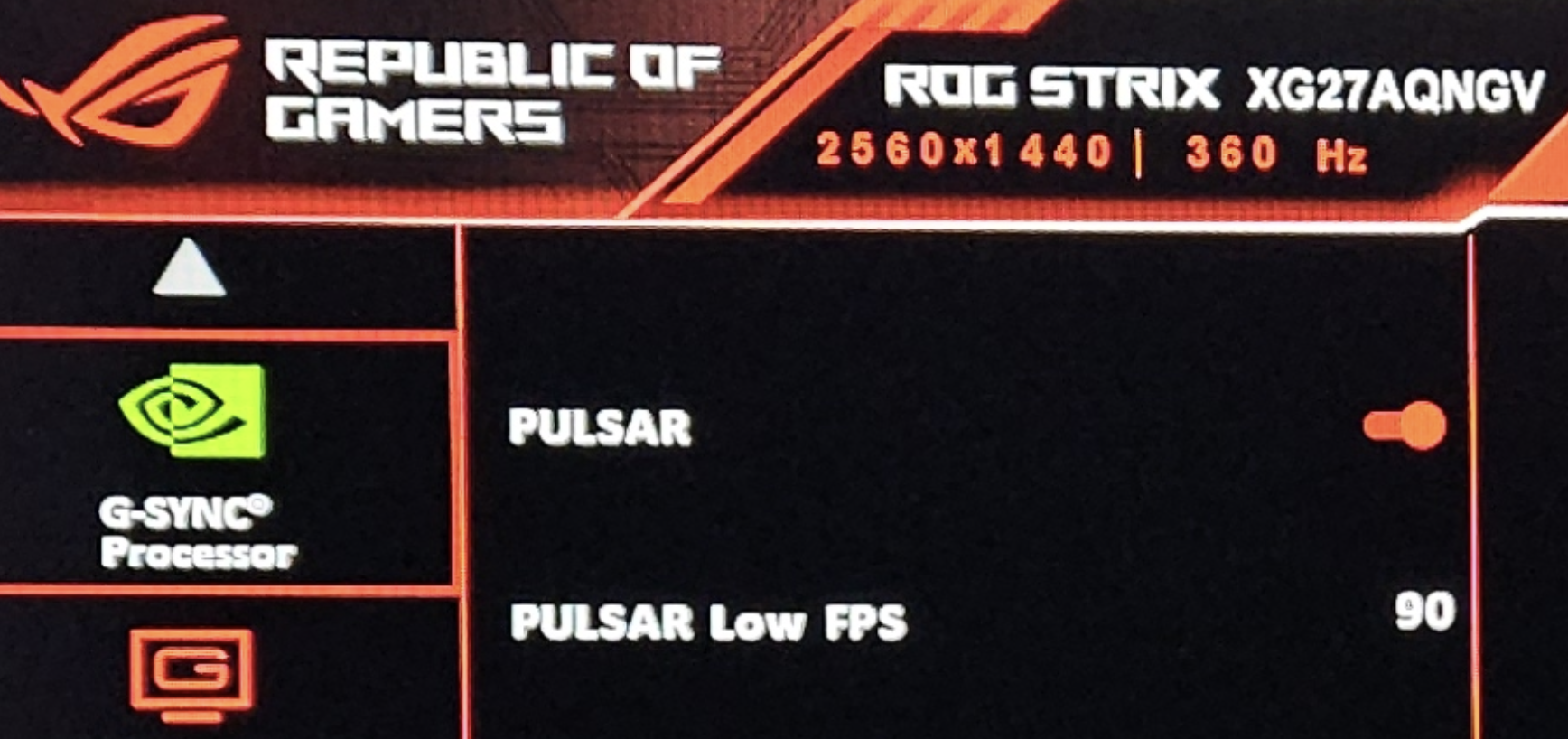
NVIDIA has agreed to release a firmware update that extends the adjustable strobe minimum Hz all the way down to 48 Hz. This enables access to PAL framerates (e.g. 50 fps emulation) as well as twice film framerates (24fps double strobe), for those who prefer it.
60 Years of Legacy 60fps 60Hz Content
There is a ginormous amount of content that is typically consumed by the same computer monitor you play competitive games on. Many users don’t use their monitors just for high end competitive gaming, but for multiple purposes, including consuming other content.
Video content. Television footage. Emulators for retro gaming. Console ports. And more.
Many users don’t put more than one computer monitor on their desk for a multipurpose gaming rig that is also used for work, education, gaming, and other entertainment. Some of us actually bought the rig to also do emulation and retro gaming too!
Accessibility Feature For Flicker-Insensitive Blur-Sensitive Users
Yes, yes. Yes, we know. Ergonomic EyeCare® FlickerFree™ PWM-Free is important. That’s for 90%+ of users. There’s way more research papers on this.
However, our Blur Busters namesake is also a long time beacon to many people who are motion blur sensitive. They come to Blur Busters to find ways to reduce display motion blur by multiple hardware and software techniques.
Users who do not get eyestrain from flicker, but actually gets massive eyestrain from motion blur. worst than headaches from Oculus Rift DK1 (non-strobed virtual reality), before Blur Busters convinced the next VR headset to strobe.
Engineers at other big brand display companies throughout China, Japan, Korea, have long set minimum strobe Hz of 75 Hz or higher, because they get eyestrain from flicker, being fully unaware of the other 1-10% of users who gets more ergonomic problems from motion blur than from flicker.
Few display motion blur reduction technologies supports 60 Hz single-strobe, except for ViewSonic’s still hugely popular XG2431 computer monitor, that is Blur Busters Approved.
One mandatory rule in a Blur Busters Approved monitor is 60 Hz strobe support. Multiple manufacturers sent samples but were unable to deliver firmware upgrades, leading to very few displays certified by Blur Busters. This disappointing situation partially led to the Blur Busters Open Source Display Initiative.
Fortunately, NVIDIA listened, and added what we asked – ability to optionally enable 60 Hz single strobe.
Rolling Strobe (Scanning Backlight) Helps Lower Pulsar Hz
G-SYNC Pulsar uses a rolling strobe using a wide-gamut backlight. A rolling strobe is perceived as less flickery than a global strobe backlight, which should help many users to comfortably adjust minimum Hz downwards a little further.
Blur Busters Will Test Firmware Upgrade
We are receiving a G-SYNC Pulsar sample with the firmware upgrade, for our testing, and will inform you of its Pulsar strobe flexibile performance. Keep tuned.